
 King Henry VIII is one of the most famous rulers of England, along with Queen Elizabeth II, Queen Victoria, and William the Conqueror. Throughout his 38 years of ruling, King Henry had six wives: two he divorced, two he beheaded, one who died of natural causes, and the final one was with Henry during his final moments. In this series, we will talk about Henry’s six wives – their lives, their relationship with Henry, and their final moments.
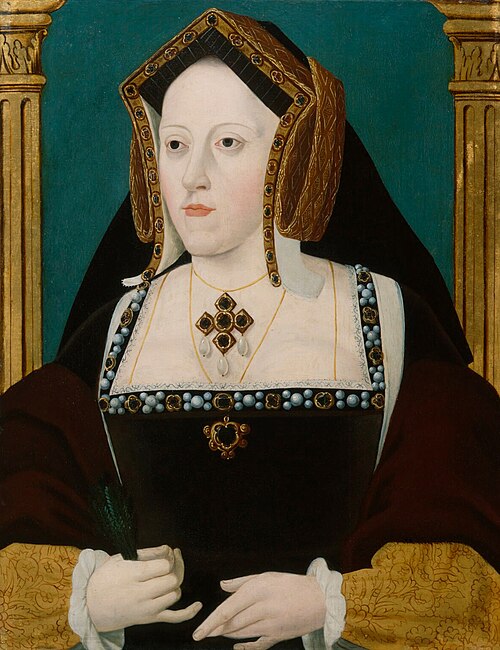
The first wife of Henry VIII was Catalina de Aragón y Castilla, a Spanish princess born in Alcalá de Henares on December 16, 1485. Catalina was the youngest daughter of Queen Isabella of Castile and King Ferdinand of Aragon. When she was three, she was betrothed to Arthur, the prince of Wales and Henry’s older brother, so England and Spain could have an alliance through marriage. At the age of 15, she moved to England to marry King Arthur and she gave herself an English name: Catherine of Aragon. She was married to Arthur for five months before he passed away due to an unknown illness. After Arthur’s death, Catherine waited seven years before she was able to marry Henry, after his accession in 1509. Before she was able to marry Henry, she was the ambassador of the Aragonese crown to England, making her the first female ambassador in European history.
Catherine was 23 when she married King Henry VIII, who was 17 at the time, and during their 24 year long relationship, Catherine remained faithful to Henry and was trusted by the people of England as their Queen Consort. She was so trusted, in fact, that when Henry was fighting in France, Catherine was assigned as a regent, someone who is appointed to administer a country because the monarch is absent or incapacitated. During the fight in France, James IV of Scotland tried to invade England and Catherine took it upon herself to ride north with armor to help protect her troops. After Catherine and her troops successfully defeated James IV, Catherine sent Henry James’ blood soaked cloak.
Outside of her rulership, Catherine was an educated woman. Since she was three, she began learning Latin, French, religious texts, Roman history, philosophy, civil and church law, and even traditional bridal skills such as embroidery, music, dance, drawing, and cooking. She was so educated in fact that she was considered smarter than her husband. “The queen is well instructed – not merely in comparison with her own sex and is no less to be respected for her piety than her erudition,” said humanist thinker, Erasmus. Henry also said that if Catherine displayed the same education and talents as her mother, Catherine would receive half of Henry’s kingdom. Catherine ended up proving herself up to the task and even more so.
When Henry came back from fighting in France, his pursuit for an heir, preferably male, began. Although it is unknown how many times Catherine was pregnant, we know she experienced many losses. In 1511, Catherine gave birth to her first child, a son named Prince Henry Duke of Cornwall. Both Henry and Catherine were ecstatic about the birth, but 52 days later he would pass away due to a common infant illness, gastroenteritis. In 1516, Catherine gave birth to Princess Mary, Mary I, who would be her only child to survive past adulthood.
As Catherine remained faithful, Henry did not. He wanted a son to be his heir, so he sought out to get one. Henry would go on to have relationships with at least four mistresses, including Anne Boleyn, one of Catherine’s ladies-in-waiting. Unlike Henry’s other mistresses, Anne was adamant on marrying Henry, whether it was for her own virtue or in pursuit of her own or her family’s ambitions, she waited to marry him.
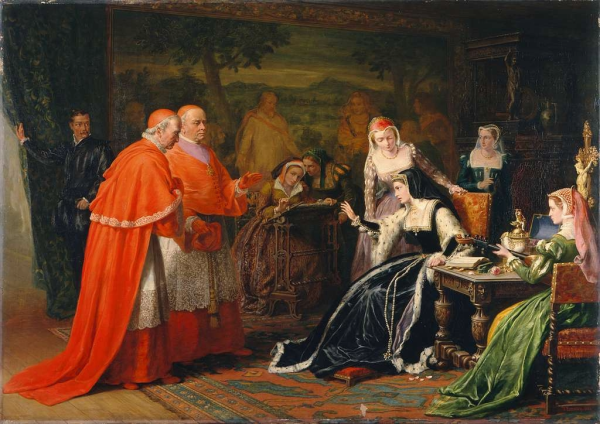 Henry became fond of Anne Boleyn, so he decided to pursue her. In order to marry Anne, Henry would have to divorce Catherine, which was very rare during the Tudor time period, still Henry was determined. Henry would need a statement from the Pope, Pope Clement VII, that proved Henry’s and Catherine’s marriage was invalid so he could not only get rid of Catherine, but as well as Mary, making Anne’s children first in line for the throne. This process is called an annulment. Henry’s annulment focused on the fact that Catherine was married to King Arthur first. Henry argued that if Catherine consummated, had sexual intercourse, with Arthur, it would make Henry and Catherine siblings, therefore them being married committed the sin of incest; this would make the marriage between Henry and Catherine illegitimate.
However, Catherine wouldn’t disappear so quickly as she believed it was her right to be Queen of England and she wanted to ensure that Mary wouldn’t be considered illegitimate. Catherine, the stubborn woman she was, appealed to defend her case to the church. Catherine swore to Henry that she had never consummated with Arthur and that she was Henry’s true wife. After years of investigating, Pope Clement VII declined the annulment.
Since Henry couldn’t have his way, he decided to break ties between Rome and the Pope, declaring himself the Supreme Head of the Church of England. This let him decide the religious future of England – allowing him to finally divorce Catherine.
Catherine was exiled in July of 1531, banished from seeing Henry and her daughter Mary ever again. She spent her last years travelling from castle to castle, losing everyone she knew, and being isolated by Henry. She ended up at Kimbolton Castle where she continued to try and reach out to Mary.
In her final days, Catherine wrote a letter to Henry because she believed that he was still her true husband. The letter read:
My most dear lord, king and husband,
The hour of my death now drawing on, the tender love I owe you forceth me, my case being such, to commend myself to you, and to put you in remembrance with a few words of the health and safeguard of your soul which you ought to prefer before all worldly matters, and before the care and pampering of your body, for the which you have cast me into many calamities and yourself into many troubles. For my part I pardon you everything and I wish to devoutly pray to God that He will pardon you also. For the rest, I commend unto you our daughter Mary, beseeching you to be a good father unto her, as I have heretofore desired. I entreat you also, on behalf of my maids, to give them marriage portions, which is not much, they being but three. For all my other servants, I solicit the wages due to them, and a year or more, lest they be unprovided for. Lastly, I make this vow, that mine eyes desire you above all things.
Catharine the Quene.
Catherine of Aragon would pass shortly after writing this letter. She passed away with cancer on January 7, 1536 making her 50 years old.
Sources:
Abernethy, Susan. “The Life and Death of Henry, Duke of Cornwall, Son of King Henry VIII.” The Freelance History Writer, 18 June 2021, thefreelancehistorywriter.com/2016/01/01/the-life-and-death-of-henry-duke-of-cornwall-son-of-king-henry-viii/.
Anderson, M. T., et al. Fatal Throne: The Wives of Henry VIII Tell All. EMBER, 2020.
“Catherine of Aragon.” Wikipedia, Wikimedia Foundation, 9 Feb. 2026, en.wikipedia.org/wiki/Catherine_of_Aragon.
“Erasmus.” Wikipedia, Wikimedia Foundation, 5 Feb. 2026, en.wikipedia.org/wiki/Erasmus.
Katherine of Aragon | Hampton Court Palace | Historic Royal Palaces, www.hrp.org.uk/hampton-court-palace/history-and-stories/katherine-of-aragon/. Accessed 9 Feb. 2026.
“Pope Clement VII.” Wikipedia, Wikimedia Foundation, 6 Feb. 2026, en.wikipedia.org/wiki/Pope_Clement_VII.
The Six Wives of Henry VIII. Meet the Wives. Catherine of Aragon | PBS, www.thirteen.org/wnet/sixwives/meet/ca_handbook_main.html. Accessed 9 Feb. 2026.
Theanneboleynfiles. “Catherine of Aragon’s Last Letter.” The Anne Boleyn Files, 18 Mar. 2024, www.theanneboleynfiles.com/catherine-of-aragons-last-letter/.