
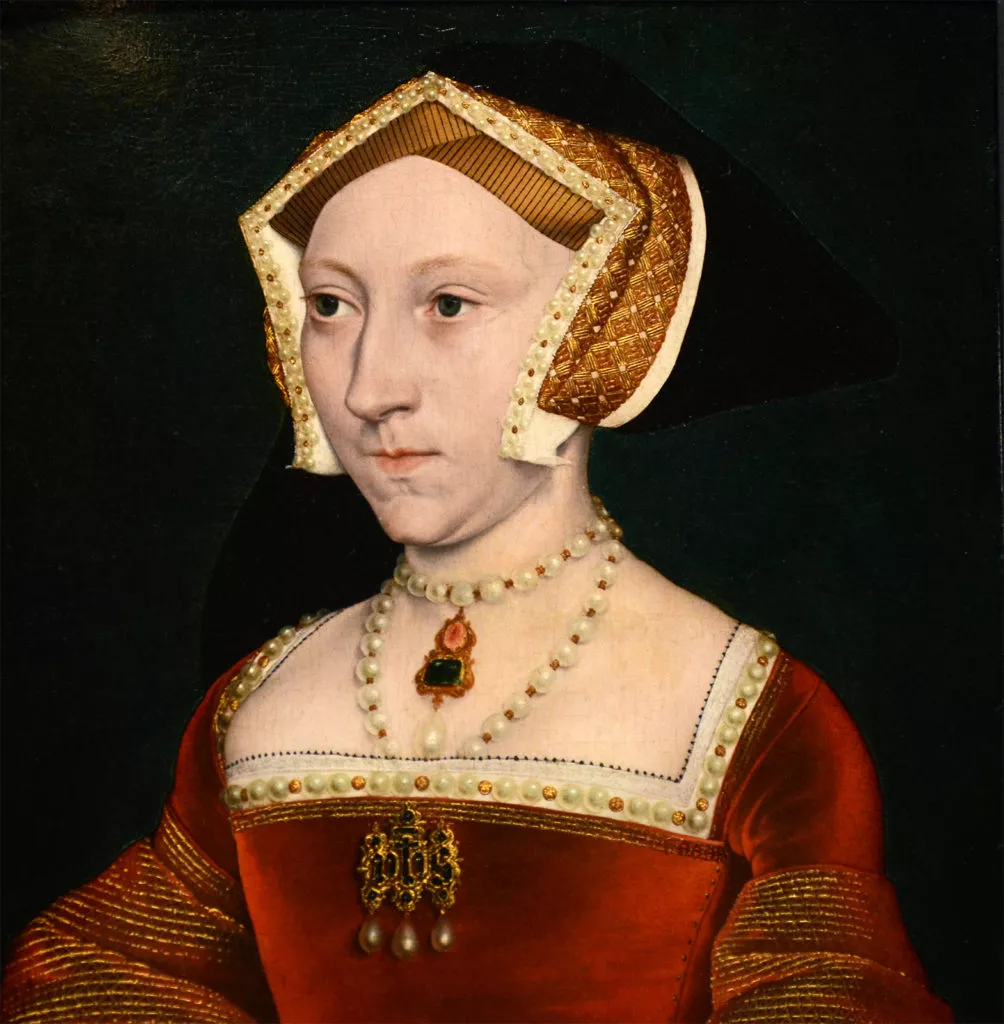
 Eleven days after the execution of King Henry VIII second wife, Anne Boleyn, Henry married his third wife. Even though after this wife, Henry would go on to have three more of them, it’s always said that Henry loved number three the most.
Jane Seymour was Henry’s third wife, born circa 1508 in Wulfhall, Wiltshire, and one of three surviving daughters of Sir John Seymour and Margery Wentworth. Unlike Catherine of Aragon and Anne Boleyn, Jane didn’t grow up in a wealthy family, in fact her family was lower gentry, growing up on a farm. During her childhood, instead of learning languages like Latin and French, she grew up learning needlework, music, and household management, which were skills expected by English women. In fact, since Jane learned household duties, instead of focusing on academics, she could barely read and write, never learning how to for her entire life.
Around 1529, Jane would arrive at court to be one of Catherine of Aragon’s, Henry VIII’s first Queen, ladies-in-waiting. She would continue being a lady-in-waiting for 7 years, serving not only Catherine, but Anne Boleyn as well.
While serving as a lady-in-waiting for Catherine of Aragon, Jane worked in a household characterized by high moral standards. This allowed her to witness the divorce between Catherine and Henry. When Catherine was sent to exile, Jane stayed at court and transitioned into the service of Anne Boleyn.
After the divorce between Catherine of Aragon and Henry, Jane would continue to serve as a lady-in-waiting for the new Queen Anne Boleyn. Anne was the very opposite of Jane, being very outspoken and was put at the centre of Henry’s religious reforms by herself. Jane sat by Anne’s side as a loyal lady-in-waiting.
After Anne gave birth to a stillborn child, Henry began to start courting other women, one of them being Jane Seymour. Jane, 28, first received a letter with a gift from Henry, 44, in March of 1536. However, Jane sent back the letter, unopened, to Henry as she believed that there was “no treasure in the world that she valued as much as her honour.” She told Henry that if he wanted to court her, he would have to call it off with Anne Boleyn first.
Similarly, this was the tactic that Anne had used when Henry had first courted her when he was with Catherine of Aragon.
Henry continued to try and court Jane, because he believed all Seymours were extremely fertile, which would give him a son. With this in mind, Henry decided to get rid of Anne Boleyn by executing her. On Friday, May 19, 1536, Anne Boleyn would be executed on (most likely) false charges of adultery with various men and even incest with her own brother. The very next day, Jane and Henry would be engaged.
 Jane Seymour’s coronation would be delayed by the plague. So unlike Catherine of Aragon and Anne Boleyn, she was never crowned as Queen, which is important as a symbolic, religious, and public formalization of their reign.
To differentiate herself from the Queens before her, Jane would choose “bound to obey and serve” as her motto. She decided to present herself as a quiet and pious woman who distanced herself from court politics. She would take strict control of her household, forcing her ladies-in-waiting to wear traditional English gable hoods, instead of the French fashions before her.
Once Jane Seymour became Queen of England, she would step into her role as a stepmother to both Elizabeth and Mary since their mothers were dead. Jane would become close to Mary as she was the only child allowed in court. Mary had also hoped to reconcile with her father and even be restored to the line of succession.
Jane encouraged Henry to reach out to his daughter, out of respect to Catherine, but Henry warned Jane to stop interfering with his decisions. Jane, being the tactful woman she was, replied that she was only interested in the King, his Kingdom, and their future children.
Although Henry did not allow Mary to be in line for the throne, he did welcome her back to court.
With Henry Fitzroy, Henry VIII’s recognised illegitimate son, expected to be named heir to the throne, dead, Henry was in more need of an heir to his throne. Later that year, the King produced a new Act of Succession, confirming that Mary and Elizabeth were now illegitimate, not allowing them to be next in line. The Act also accounted for children produced by any future queen. However in March 1537, Jane got pregnant with what astrologers believed to be a boy.
On October 12, 1537, after two long days and three nights, Jane would give birth to a baby, Edward VI. Jane had successfully delivered Henry a son and future heir to the throne.
After the excruciating labor, Jane seemed to be healing well. There were already plans in motion for her churching, a ceremony allowing her out of confinement and back into court life, but her health started to deteriorate.
On October 24, 1537, just 12 days after giving birth, Jane Seymour died at Hampton Court Palace. Although it is unknown how she died, it is believed she had childbed fever, an infection caused by poor hygiene during labour or other other post-birth complications.
Henry would go on to mourn his wife for years to come, even getting a painting commissioned of him, his three children, and his most beloved wife, Jane Seymour. He wrote to Francis I of France in a letter shortly after Jane’s death about how he was affected by the loss. The short letter wrote:
Divine Providence hath mingled my joy with the bitterness of the death of her who brought me this happiness.
Henry R.
Sources:
Anderson, M. T., et al. Fatal Throne: The Wives of Henry VIII Tell All. EMBER, 2020.
Ann Foster, et al. “Jane Seymour: A Well-Behaved Woman History Too Often Forgets.” Ann Foster, 28 Mar. 2018, annfosterwriter.com/a-well-behaved-woman-history-too-often-forgets/.
Jane Seymour | Hampton Court Palace | Historic Royal Palaces, www.hrp.org.uk/hampton-court-palace/history-and-stories/jane-seymour/. Accessed 26 Feb. 2026.
“Jane Seymour, Queen of England.” Tudor Times, tudortimes.co.uk/people/jane-seymour. Accessed 26 Feb. 2026.
“Jane Seymour.” Wikipedia, Wikimedia Foundation, 22 Feb. 2026, en.wikipedia.org/wiki/Jane_Seymour.
“Landed Gentry.” Wikipedia, Wikimedia Foundation, 24 Nov. 2025, en.wikipedia.org/wiki/Landed_gentry.
The Six Wives of Henry VIII. Meet the Wives. Jane Seymour | PBS, www.thirteen.org/wnet/sixwives/meet/js_handbook_fate2.html. Accessed 26 Feb. 2026.
“Wulfhall.” Wikipedia, Wikimedia Foundation, 1 Oct. 2025, en.wikipedia.org/wiki/Wulfhall.