
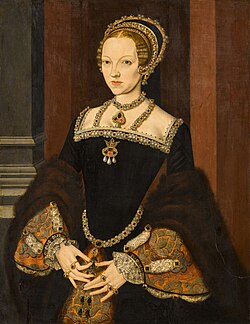

A year after Katherine Howard was executed at the Tower of London, Henry VIII was unsure about marrying again. However Henry soon laid eyes onto a married woman while at court. Once her husband passed, Henry didn’t wait to ask her to marry him. After surviving a harsh marriage to Henry, she made it out.
Henry’s sixth and final wife was Catherine Parr, the eldest child of Sir Thomas Parr, lord of the manor of Kendal in Westmorland, and Matilda ‘Maud’ Green, daughter and co-heiress of Sir Thomas Green, lord of Greens Norton, Northamptonshire, and Joan Fogge. Catherine was born circa July 1512 in what is believed to be Kendal Castle in Westmorland, however there is proof that she hadn’t been born there, although it is unknown.
Sir Thomas, Catherine’s father, was a close companion to Henry VIII and Maud Green, Catherine’s mother, was also a close friend and attendant of Catherine of Aragon. It’s believed that, due to this connection to Catherine of Aragon, Catherine Parr was named after Henry’s first wife.
Sir Thomas died in November of 1517, due to an unknown illness when Catherine was very young leaving Maud to oversee his estates and raise their children. Maud was a practical, independent woman who valued education, which became influential in Catherine’s adult life – being fluent in French, Italian, Latin, and Spanish.
When Catherine was 16, she married Sir Edward Borough, who was 21 at the time. We don’t know much about this relationship, just that he was Catherine’s first husband. However, in 1533, just four years after their marriage, Sir Edward would pass due to an unknown illness and Catherine would become a widow at 20.
While with Sir Edward, Catherine’s mother, Maud, died of natural causes.
On top of being a young widow, Catherine would now have to live without both her father and mother.
In 1534, Catherine would marry the twice-widowed John Neville, 3rd Baron Latimer. Catherine was very fond of John and settled into her new role as ‘Lady Latimer,’ mistress of her household and stepmother to John’s two children.
In January of 1537, Catherine and her step-children were held hostage at Snape Castle during the uprising of the “Bigod Rebellion,” led by Sir Francis Bigod of Settrington. Word was sent to John, also known as Lord Latimer, who was returning from London, that if he did not return immediately they would kill his family. John somehow convinced the rebels into releasing his family, but the aftermath would be taxing on the entire family.
After the Rebellion, Catherine and her family moved south, though John would frequently return north on behalf of the government.
Catherine’s siblings stayed in London due to them both being in the Tudor court, so she probably enjoyed moving down south. Some historians argue that Catherine joined the household of Mary, Henry’s eldest child, daughter of Catherine of Aragon, Henry’s first wife, however, it is more likely that her connections at court just made Catherine a frequent face at court – around this time Henry would begin to lay his eyes on her.
John would pass away from an illness on March 2, 1543. Catherine once again became a widow, this time at the age of 30. Instead of sulking about John’s death, she wanted to marry again, but this time to someone she truly loved.
William, Catherine’s brother, soon introduced Catherine to Thomas Seymour, the brother of Jane Seymour, Henry’s third wife, and Catherine fell in love.
Thomas would also begin to fall for Catherine.
However, Henry, knowing now that Catherine Parr was widowed, took this opportunity to propose to her.
Catherine, ever in love with Thomas, still chose to marry Henry, not for love, but for survival. She knew that if she said no to the King there would be many consequences and she didn’t want anything to happen to Thomas, so she dealt with the marriage.
Catherine, 31, and Henry, 52, would be married on July 12, 1543 in the Queen’s Closet at Hampton Court Palace. The ceremony was small and private, limited just to family and close friends.
Once she became Queen, Catherine earned the love and trust of Henry’s three children, Mary, Elizabeth, and Edward. Catherine was supportive and a huge part of her stepchildren’s lives. She even encouraged the studies of Elizabeth, 9, and Edward, 5. Although she became very close with her stepchildren, the most important thing she did for them was restoring the gap between them and their father, Henry. Reports from Henry’s court show that Catherine was an important player in Henry’s decision to restore Mary and Elizabeth’s line of succession.
While Catherine became a crucial part of the family, she also helped shape England’s allies abroad.
In 1544, Henry allied with Chales V and left to wage war in France. Catherine was appointed as his Regent-General, empowered to rule in his name with the support of a carefully chosen regency council. This action was a sign of Henry’s trust in Catherine. She signed five royal proclamations as regent, supporting her husband’s war effort whilst overseeing domestic issues.
While Henry was away, Catherine, mindful of the king’s sensitivity to perceived threats to his authority, spiked her letters with strong doses of affection and humility. One of these letters read:
Although the distance of time and account of days neither is long nor many of your majesty’s absence, yet the want of your presence, so much desired and beloved by me, maketh me that I cannot quietly pleasure in anything until I hear from your majesty. The time, therefore, seemeth to me very long, with a great desire to know how your highness hath done since your departing hence, whose prosperity and health I prefer and desire more than mine own. And whereas I know your majesty’s absence is never without great need, yet love and affection compel me to desire your presence.
Again, the same zeal and affection force me to be best content with that which is your will and pleasure. Thus love maketh me in all things to set apart mine own convenience and pleasure, and to embrace most joyfully his will and pleasure whom I love. God, the knower of secrets, can judge these words not to be written only with ink, but most truly impressed on the heart. Much more I omit, lest it be thought I go about to praise myself, or crave a thank; which thing to do I mind nothing less, but a plain, simple relation of the love and zeal I bear your majesty, proceeding from the abundance of the heart. Wherein I must confess I desire no commendation, having such just occasion to do the same. I make like account with your majesty as I do with God for his benefits and gifts heaped upon me daily, acknowledging myself a great debtor to him, not being able to recompense the least of his benefits; in which state I am certain and sure to die, yet I hope in His gracious acceptation of my goodwill. Even such confidence have I in your majesty’s gentleness, knowing myself never to have done my duty as were requisite and meet for such a noble prince, at whose hands I have found and received so much love and goodness, that with words I cannot express it. Lest I should be too tedious to your majesty, I finish this my scribbled letter, committing you to the governance of the Lord with long and prosperous life here, and after this life to enjoy the kingdom of his elect.
From Greenwich, by your majesty’s humble and obedient servant,
Catharine the Queen.
Unlike Henry, Catherine was very passionate and a supporter of religious reform. She enjoyed reading and discussing new reformist ideas, and even began writing books of her own. Catherine’s early works were published anonymously but she did produce two books in her own name; Payers or Meditations, the first work published in the name of an English Queen, and The Lamentation of a Sinner, a self-reflective piece.
The last years of Henry’s reign were a dangerous time for religious reformers, especially Catherine.
With Henry’s health deteriorating, Prince Edward was set to inherit the throne. Since Edward was too young to rule on his own, he needed a regent. Since Catherine showed that she was capable of leading England, people worried that she would become regent. People became worried. They believed that if she became regent, her reformist beliefs would dominate the next reign.
Even though Henry was fond of Catherine, he was still a religious conservative at heart. He became frustrated with Catherine’s debates about reform and revealed his frustrations to Bishop Stephen Gardiner.
Steven Gardiner would take this opportunity to implicate Catherine in heresy, which in turn launched an investigation into the Queen and her ladies.
The conspirators would search the rooms of Catherine’s ladies while looking for evidence. They would also interrogate Anne Askew, an English writer, poet, and Protestant preacher. Anne, would later be burned at the stake for heresy, refused to implicate the Queen.
However, Catherine was smart. When she became aware of her arrest warrant, she took to her bed and claimed she was terribly ill. Henry would soon arrive at her bedside and Catherine would ask if he was angry with her.
When he explained why he was upset, Catherine promised that she only argued with Henry to learn from him and take his mind off his injuries and illnesses. She called herself a ‘silly poor woman’ and described Henry as her ‘only anchor, supreme head and governor here on earth, next to God.’
After Henry took the bait and forgave Catherine. The couple were “perfect friends again” and when men tried to take Catherine away to the Tower of London, Henry sent them away.
Catherine Parr had successfully survived what the Queens before her could not: a plot to remove her from Henry’s side.
After this incident, Catherine and Henry would remain happily married without any more problems. However, on January 28, 1547 Henry would finally succumb to his illnesses and pass at Whitehall Palace at the age of 55.
 Shortly before he died, Henry granted Catherine an annual income of £7,000, over £2 million pounds or $2,665,570 U.S. dollars, to maintain her own household, servants, and lifestyle as a widow. Even further, he ordered that, after his death, Catheine should be given the respect of a queen of England, as if Henry were still alive. After the coronation of her stepson, Edward VI, on January 31, 1547, Catherine retired from court and moved into her home at Old Manor in Chelsea.
In February of 1547, Catherine would reconnect with Thomas Seymour, and they would be married in May of 1547, without King Edward VI’s permission. This action would damage the relationship between Catherine and Edward as well as the relationship between Catherine and Mary, since they believed that it was disrespectful for her to marry so soon after Henry’s death.
On the other hand, Catherine remained on good terms with Elizabeth, who began living with her and Thomas. However, Thomas proved to be a poor guardian for the princess as he began sexually harassing her, even visiting her bedroom while she was sleeping. After being caught with his arms around Elizabeth, Catherine would send her away – both to protect her own marriage and preserve Elizabeth’s reputation.
In December of 1547, Catherine became pregnant. Both Catherine and Thomas were excited to welcome their first child, but Thomas worried about Catherine’s health.
On August 30, 1548, Catherine would give birth to a daughter and named her Mary, after Mary I, Catherine’s stepdaughter.
Yet, this joy was short-lived. On September 5, 1548, Catherine, contracted with childbed fever, would pass away. Catherine, aged 36, would be buried in St Mary’s Church at Sudeley Castle in Gloucestershire.
Sources:
Anderson, M. T., et al. Fatal Throne: The Wives of Henry VIII Tell All. EMBER, 2020.
“Anne Askew.” Wikipedia, Wikimedia Foundation, 6 Sept. 2025, en.wikipedia.org/wiki/Anne_Askew.
“Catherine Parr and Thomas Seymour – Part Two.” The Elizabeth Files, 5 Mar. 2021,
www.elizabethfiles.com/catherine-parr-and-thomas-seymour-part-two/3660/.
“Catherine Parr.” Wikipedia, Wikimedia Foundation, 2 Mar. 2026, en.wikipedia.org/wiki/Catherine_Parr.
“John Neville, 3rd Baron Latimer.” Wikipedia, Wikimedia Foundation, 27 Jan. 2026, en.wikipedia.org/wiki/John_Neville,_3rd_Baron_Latimer.
Katherine Parr: Scholar, Stepmother, Survivor | Hampton Court Palace | Historic Royal Palaces, www.hrp.org.uk/hampton-court-palace/history-and-stories/katherine-parr/. Accessed 3 Mar. 2026.
The Six Wives of Henry VIII. Meet the Wives. Catherine Parr | PBS, www.thirteen.org/wnet/sixwives/meet/cp_handbook_main.html. Accessed 3 Mar. 2026.
“Stephen Gardiner.” Wikipedia, Wikimedia Foundation, 1 Mar. 2026, en.wikipedia.org/wiki/Stephen_Gardiner.
tudorqueen6, and tudorqueen6. “Family of Queen Katherine Parr: Sir John Neville, 3rd Lord Latimer.” Tudorqueen6 by Meg McGath, 17 Nov. 2013,
tudorqueen6.com/2012/11/17/family-of-queen-katherine-parr-sir-john-neville-3rd-lord-latimer/.
tudorqueen6, et al. “Sir Edward Borough: First Husband of Katherine Parr.” Tudorqueen6 by Meg McGath, 7 Jan. 2026, tudorqueen6.com/2012/09/07/sir-edward-borough-first-husband-of-katherine-parr/.